


6 Common Causes of Wire Rope Hoist Failures and How to Prevent Them
Wire rope hoists are widely used across manufacturing plants, warehouses, construction sites, and heavy industrial facilities in Malaysia. They are designed for durability and high-load performance, but like all lifting equipment, they are not immune to failure.
In most cases, wire rope hoist failures are not sudden events. They develop over time due to poor maintenance, incorrect operation, or unsuitable working conditions.
Understanding the root causes is the most effective way to reduce downtime, improve safety, and extend equipment lifespan.
Below are six of the most common causes of wire rope hoist failures and practical ways to prevent them.
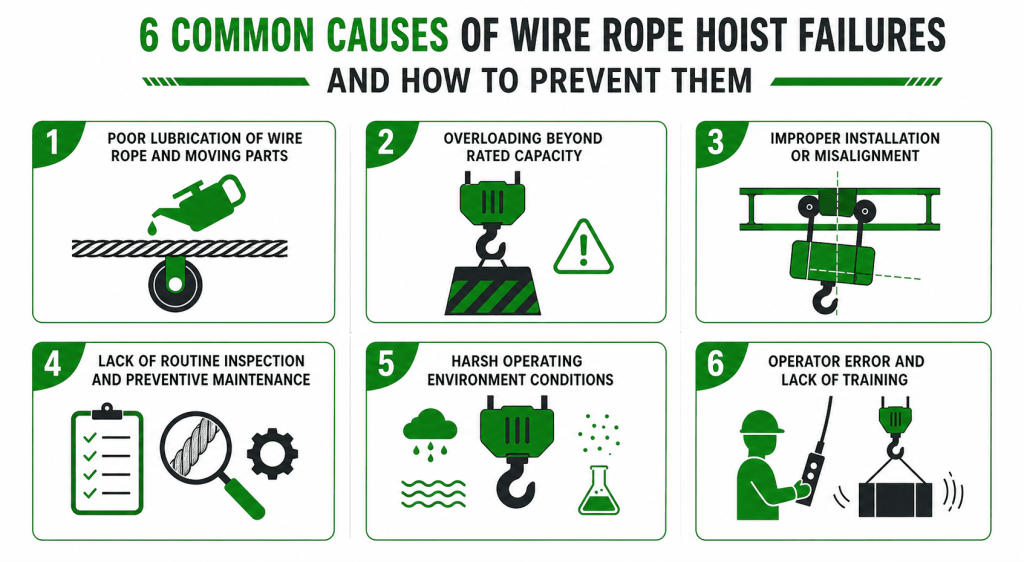
1. Poor Lubrication of Wire Rope and Moving Parts
One of the most overlooked causes of hoist failure is insufficient or incorrect lubrication.
Wire ropes experience constant friction between strands and pulleys. Without proper lubrication, this leads to:
- Internal wear and friction damage
- Rust and corrosion
- Reduced flexibility of the rope
- Premature wire breakage
In Malaysia’s humid environment, corrosion risk is even higher, especially in coastal or outdoor facilities.
How to Prevent It
- Use manufacturer-approved wire rope lubricants
- Apply lubrication at scheduled maintenance intervals
- Ensure even penetration into rope strands
- Avoid over-lubrication that attracts dust and debris
Regular lubrication is a low-cost step that significantly improves wire rope hoist Malaysia performance and lifespan.
2. Overloading Beyond Rated Capacity
Overloading is one of the fastest ways to damage a hoist system.
Every wire rope hoist is designed with a specific safe working load (SWL). When operators exceed this limit, it can cause:
- Wire rope deformation or snapping
- Motor overheating
- Gearbox strain
- Structural failure of lifting components
Even occasional overload events can reduce long-term reliability.
How to Prevent It
- Clearly display load capacity near the hoist
- Train operators on safe lifting limits
- Use load limiters or overload protection systems
- Conduct regular supervision in industrial environments
A disciplined loading policy is critical for industrial hoist safety compliance.
3. Improper Installation or Misalignment
Incorrect installation is a hidden but serious cause of early hoist failure.
If a wire rope hoist is not properly aligned during installation, it can lead to:
- Uneven rope wear
- Drum or pulley damage
- Excessive vibration
- Reduced lifting efficiency
Misalignment often happens when installation is rushed or not handled by qualified technicians.
How to Prevent It
- Ensure installation is performed by certified engineers
- Use precision alignment tools during setup
- Conduct load testing before operation
- Verify runway beam and structural support integrity
Proper installation ensures the system operates within designed engineering tolerances.
4. Lack of Routine Inspection and Preventive Maintenance
Many hoist failures occur simply because issues were not detected early.
Wire rope hoists in Malaysia operate under heavy mechanical stress, and components naturally degrade over time. Without inspections, small issues become major failures.
Common undetected problems include:
- Wire rope strand breakage
- Hook deformation
- Brake wear
- Gearbox oil degradation
- Electrical contact damage
How to Prevent It
- Implement a scheduled inspection plan (daily, monthly, yearly)
- Record all maintenance activities
- Replace worn components before failure occurs
- Follow manufacturer maintenance guidelines strictly
A structured maintenance system is essential for reducing wire rope hoist failure risks in Malaysia industrial environments.
5. Harsh Operating Environment Conditions
Environmental conditions play a major role in equipment lifespan.
In Malaysia, high humidity, heat, dust, and chemical exposure can significantly affect hoist performance.
These conditions can cause:
- Corrosion of wire ropes and hooks
- Electrical component failure
- Reduced lubrication effectiveness
- Faster wear of mechanical parts
Industries such as palm oil processing, marine operations, and heavy fabrication are especially exposed.
How to Prevent It
- Use corrosion-resistant hoist specifications where needed
- Install protective covers or enclosures
- Schedule more frequent maintenance in harsh environments
- Store equipment properly when not in use
Selecting the right hoist type for the environment is a key engineering decision, not just a procurement choice.
6. Operator Error and Lack of Training
Human error remains one of the leading causes of lifting equipment incidents.
Improper use of wire rope hoists can result in:
- Sudden load swings
- Shock loading
- Rope misalignment
- Unsafe lifting angles
- Emergency stop misuse
Even advanced hoisting systems cannot compensate for incorrect operation.
How to Prevent It
- Provide structured operator training programs
- Enforce standard operating procedures (SOPs)
- Conduct safety briefings regularly
- Restrict operation to trained personnel only
Strong safety culture is just as important as mechanical reliability.
Summary Table: Causes vs Prevention
| Common Cause | Main Risk | Prevention Method |
|---|---|---|
| Poor lubrication | Wear and corrosion | Regular lubrication schedule |
| Overloading | Structural failure | Load monitoring systems |
| Misalignment | Uneven wear | Professional installation |
| Poor maintenance | Unexpected breakdown | Routine inspections |
| Harsh environment | Corrosion and damage | Protective measures |
| Operator error | Safety incidents | Training and SOP enforcement |
Why Preventive Maintenance Matters for Wire Rope Hoists
Preventing failures is always more cost-effective than repairing breakdowns.
A well-maintained wire rope hoist provides:
- Higher operational safety
- Reduced downtime
- Longer equipment lifespan
- Lower repair and replacement costs
- Better workplace productivity
For industrial operations in Malaysia, where equipment often runs under demanding conditions, preventive maintenance is not optional. It is a necessity.
Need Reliable Wire Rope Hoist Solutions in Malaysia?
If you are looking for industrial-grade wire rope hoists, inspection support, or lifting system consultation, working with an experienced supplier ensures better safety and long-term performance.
Final Thoughts
For Wire rope hoist in Malaysia, failures rarely happen without warning. They are usually the result of small issues that build up over time.
By addressing lubrication, load management, installation quality, maintenance routines, environmental exposure, and operator training, businesses can significantly improve reliability and safety.
Choosing the right hoisting system and maintaining it correctly is one of the most important investments for long-term industrial efficiency.
Frequently Asked Question (FAQs)
The lifespan depends on usage, load conditions, and maintenance. With proper care and regular servicing, a wire rope hoist can last 10–20 years. However, high-duty applications may require more frequent part replacements.
Basic visual inspections should be done daily before use. More detailed inspections are typically recommended monthly, with a full professional inspection at least once a year or according to local safety regulations.
Common signs include broken wire strands, kinks, corrosion, flattening, or unusual noises during operation. If any of these appear, the hoist should be stopped and inspected immediately.
Minor issues like worn brakes or damaged electrical components can often be repaired. However, if the wire rope, drum, or structural components are severely damaged, replacement is usually the safer and more cost-effective option.
Key safety features include overload protection, emergency stop functions, limit switches, thermal protection, and reliable braking systems. These features help prevent accidents and protect both operators and equipment.
Disclaimer Statement
We hope you found this article informative. Our content is intended for general informational purposes only and does not constitute advice or necessarily reflect the full range of services offered by Power Tiek Sdn Bhd
Readers are advised to consult with a qualified industry professional and contact our experts for crane recommendations specific to their individual project needs. While we strive for accuracy and completeness in our blog posts, we cannot guarantee they are error-free. Power Tiek Sdn Bhd assumes no responsibility for any errors or omissions.