

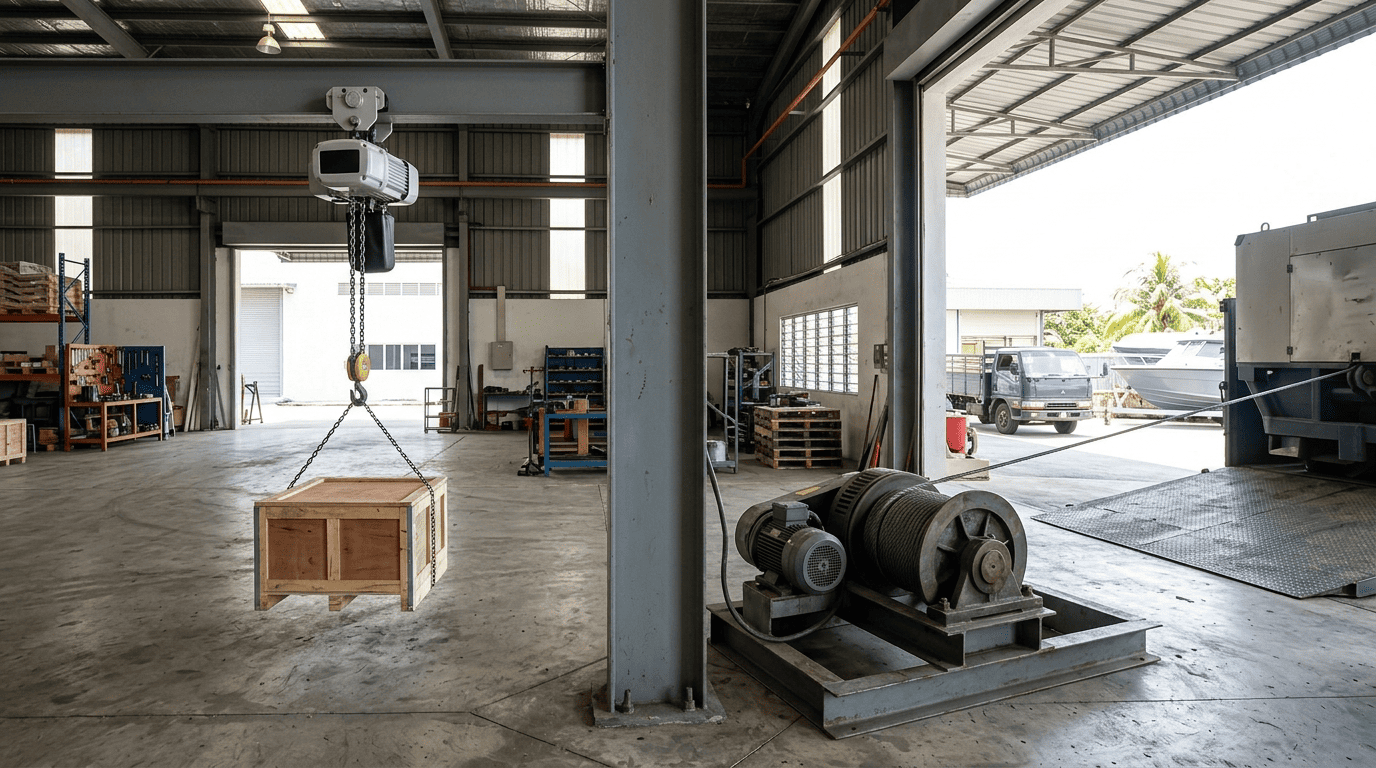
If you’ve been shopping for lifting or pulling equipment in Malaysia, you’ve probably come across both electric winches and electric hoists — and wondered: aren’t they basically the same thing?
They’re not. While both use an electric motor to move heavy loads, they are designed for very different jobs. Choosing the wrong one can lead to inefficiency, safety risks, and unnecessary costs. This guide breaks down exactly what sets them apart so you can make the right call for your operation.
What Is an Electric Hoist?
An electric hoist is a lifting device designed to raise and lower loads vertically. It is typically mounted on a fixed beam, monorail, or overhead crane system and uses either a chain or wire rope to lift the load straight up and down.
In Malaysia, electric hoists are widely used in factories, warehouses, workshops, and construction sites — anywhere you need to repeatedly lift heavy materials to a working height. Common applications include lifting engine blocks in automotive workshops, moving raw materials on a production line, or loading goods onto elevated platforms.
Key characteristics of an electric hoist:
- Primary motion: Vertical lifting and lowering
- Mounting: Fixed or trolley-mounted on a beam or crane
- Load path: Straight up and down
- Common types: Electric chain hoist, wire rope hoist
- Duty cycle: Designed for frequent, repetitive lifts
What Is an Electric Winch?
An electric winch is a pulling device designed to move loads horizontally — or at an angle — by winding a wire rope or synthetic rope around a drum. Unlike a hoist, it is built for pulling, dragging, or tensioning rather than pure vertical lifting.
In Malaysia, electric winches are commonly used in marine and port operations, vehicle recovery, construction site material pulling, and stage rigging. You will also find them on tow trucks, offshore platforms, and logging operations.
Key characteristics of an electric winch:
- Primary motion: Horizontal pulling or angled tension
- Mounting: Fixed on a vehicle, ground frame, wall, or platform
- Load path: Along the ground, on a slope, or at low angles
- Common types: Wire rope winch, synthetic rope winch
- Duty cycle: Typically intermittent, not designed for continuous lifts
Key Differences Side by Side
1. Direction of Load Movement
This is the most fundamental difference. Hoists lift loads vertically. They are engineered with braking systems, gear ratios, and motor ratings specifically for fighting gravity in a straight line.
Winches pull loads horizontally or at a low angle. Their drum and gear systems are built for sustained horizontal tension. Using a winch for repeated vertical lifting is dangerous — most winches are not rated for it and lack the dynamic braking needed to hold a suspended load safely.
2. Safety Braking Systems
Electric hoists are built with a mechanical load brake (often a disc brake or DC injection brake) that automatically holds the load in mid-air if power is cut. This is a critical safety feature for any suspended load.
Electric winches typically rely on the motor’s resistance or a basic ratchet/pawl system to hold a load. This is sufficient for a load resting on the ground, but insufficient for a freely suspended load. A power failure with an improperly used winch can result in an uncontrolled drop.
3. Drum vs Chain/Rope Design
Hoists — particularly chain hoists — store chain in a neat bag or bucket. Wire rope hoists use a grooved drum designed for precise layering. Both systems are optimised for vertical operation and short rope/chain travel.
Winches use a larger, wider drum designed to store long lengths of wire rope — sometimes 20 to 100 metres or more. This suits long-distance pulling across a site, but is oversized and inefficient for short vertical lifts.
4. Duty Cycle and Continuous Use
In a Malaysian factory running two or three shifts, an electric hoist may perform dozens or hundreds of lift cycles per day. Hoists are rated for this — they are built with appropriate motor insulation classes and thermal protection for repetitive use.
Winches are designed for intermittent, occasional use. Pulling a vehicle out of a ditch or tensioning a cable once every few hours is what they are made for. Running a winch continuously like a hoist will overheat the motor and shorten its lifespan significantly.
5. Capacity and Precision
Electric hoists offer precise load positioning — you can lower a load to within millimetres of the target. This is important in manufacturing and assembly operations.
Winches prioritise pulling force over precision. They are often rated by line pull (in kilograms or tonnes of tension) rather than a clean lifting capacity, and fine positioning is not their strength.
Which One Do You Need in Malaysia?
Choose an electric hoist if:
- You need to lift materials vertically in a factory, warehouse, or workshop
- The lifting task is repetitive — multiple times per shift
- You need the load to be held safely in mid-air
- You are mounting it on an overhead beam, gantry, or crane
Choose an electric winch if:
- You need to pull, drag, or tension a load horizontally
- The application is vehicle recovery, marine, or slope-based material movement
- The use is intermittent — a few times per day at most
- You need a long rope length to cover distance across a site
A Common Mistake in Malaysian Workshops
One mistake we see regularly is workshop owners purchasing a cheap electric winch and mounting it overhead to use as a hoist. On the surface it looks similar — motor, rope, hook. But the winch lacks a proper load brake, is not rated for vertical suspension, and is often not designed to handle the duty cycle of regular lifts.
This is a serious safety hazard and may also put you in violation of DOSH (Department of Occupational Safety and Health Malaysia) requirements for lifting equipment. Always use equipment that is rated and certified for its intended application.
Final Thoughts
Both electric winches and electric hoists are valuable pieces of equipment — they are just built for different jobs. Understanding the difference helps you invest in the right tool, operate it safely, and stay compliant with Malaysian workplace safety regulations.
If you are unsure which solution fits your operation, speak to a specialist supplier who can assess your load, application, and site conditions before recommending the right equipment.
Disclaimer Statement
We hope you found this article informative. Our content is intended for general informational purposes only and does not constitute advice or necessarily reflect the full range of services offered by Power Tiek Sdn Bhd
Readers are advised to consult with a qualified industry professional and contact our experts for crane recommendations specific to their individual project needs. While we strive for accuracy and completeness in our blog posts, we cannot guarantee they are error-free. Power Tiek Sdn Bhd assumes no responsibility for any errors or omissions.