

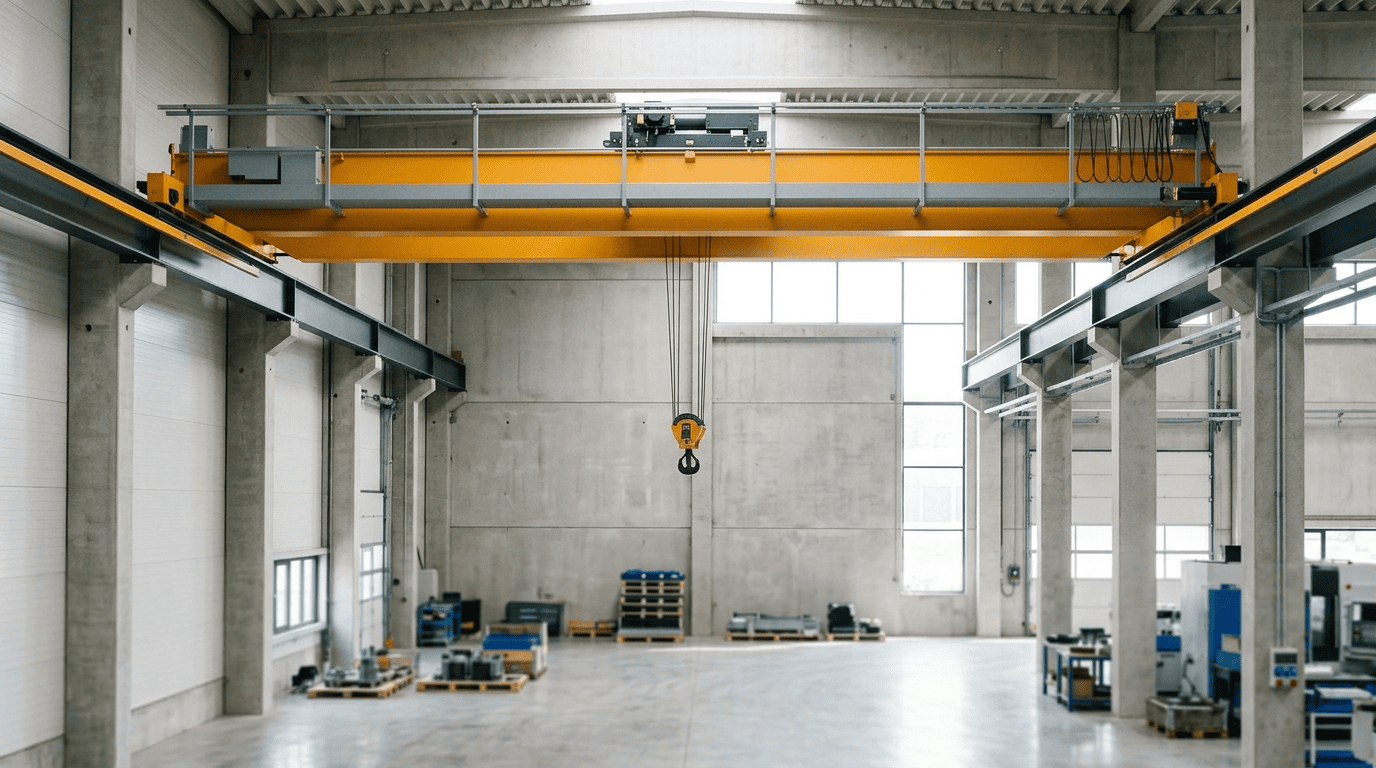
If you’re planning to install an overhead crane in your facility, one of the first questions you’ll ask is: how much does it actually cost? The honest answer is — it depends. But “it depends” isn’t helpful when you’re trying to plan a budget, so this article breaks down the real pricing factors, typical cost ranges, and what to watch out for when getting quotes in Malaysia.
Why Overhead Crane Pricing Varies So Much
Walk into any two factories in Malaysia and you might find one overhead crane that cost RM30,000 and another that cost RM300,000. Both are “overhead cranes” — but they serve completely different needs.
The price of an overhead crane is determined by a combination of factors: capacity, span, lift height, crane type, brand, installation complexity, and whether you need supporting steel structure. Understanding each factor helps you interpret quotes accurately and avoid paying for more than you need.
Overhead Crane Types and General Price Ranges
Single Girder Overhead Crane
This is the most common and cost-effective option for light to medium duty applications. It uses one main beam and is suitable for capacities typically ranging from 1 tonne to 10 tonnes.
Estimated price range: RM25,000 – RM120,000
This range covers the crane unit itself. A basic 2-tonne single girder crane with a modest span will sit at the lower end, while a 10-tonne unit with a longer span and higher lift height moves toward the upper range.
Double Girder Overhead Crane
Double girder cranes use two main beams and are suited for heavier capacities, longer spans, and higher duty cycle operations. They offer better rigidity, higher hook approach, and longer service life under demanding conditions.
Estimated price range: RM80,000 – RM400,000+
A 10-tonne double girder crane for a medium-sized factory will typically fall between RM120,000 and RM200,000. Heavy-duty units at 20 to 50 tonnes and above can exceed RM400,000 depending on specifications.
Factors That Affect the Final Price
1. Lifting Capacity (SWL)
The safe working load is the single biggest driver of cost. Every jump in capacity — from 1 tonne to 3 tonnes to 5 tonnes to 10 tonnes — requires stronger structural components, larger motors, heavier wire rope hoists, and more robust end trucks. Price does not increase in a straight line; it accelerates as capacity grows.
2. Span (Bay Width)
The span is the horizontal distance between the two runway rails — essentially, the width your crane needs to cover. A 10-metre span costs significantly less than a 20-metre span because longer beams require heavier steel, more material, and more precise engineering to prevent deflection under load.
Every additional metre of span adds cost, especially for double girder cranes where beam weight and stiffness are critical.
3. Lift Height
The higher the hook needs to travel, the longer the wire rope or chain required, and the taller the hoist unit needs to be. Higher lift heights also mean longer festoon cable systems and more complex electrical installations. For facilities with high bays — above 8 to 10 metres — expect a noticeable price increase compared to standard heights.
4. Runway and Supporting Structure
Many buyers focus on the crane unit price and forget about the runway. If your facility already has steel columns and runway beams in place, you only need to install the crane. But if you are building a new facility or retrofitting an existing one without crane rails, the runway structure — steel columns, runway beams, rail clips, and alignment — can add RM20,000 to RM100,000 or more to the total project cost depending on bay size and height.
5. Duty Class
Overhead cranes are classified by duty class (FEM or ISO standards) based on how frequently they will be used. A crane that runs 10 cycles per day has very different component requirements from one running 100 cycles per day. Higher duty class cranes use heavier motors, better gearboxes, and more robust hoists — all of which increase cost.
For light manufacturing or occasional use, a standard duty class is fine. For automotive production lines, steel mills, or high-throughput warehouses, you need a higher duty class — and should budget accordingly.
6. Brand and Origin
Crane components in Malaysia come from a range of origins — European, Japanese, Korean, Chinese, and locally assembled. European and Japanese brands (such as those from established crane component manufacturers) carry a premium price but are known for longer service life and better availability of spare parts. Chinese-made components have improved significantly in quality and offer competitive pricing for light to medium duty applications.
The right choice depends on your operational demands, not just your budget.
7. Control System
A basic pendant push-button control is the most affordable option. Radio remote control (wireless) adds convenience and operator safety but increases cost. For automated production lines, PLC-based controls with variable frequency drives (VFD) for smooth acceleration add further to the price but deliver precision and energy efficiency.
8. Installation and Commissioning
Installation costs in Malaysia typically range from RM5,000 to RM30,000+ depending on the size and complexity of the crane, the height of the facility, and the accessibility of the site. This includes mechanical assembly, electrical wiring, load testing, and DOSH inspection preparation. Always confirm whether installation is included in your supplier’s quote.
Recurring Costs to Factor In
The purchase price is only part of the total cost of ownership. Budget for:
- Annual inspection and load testing — required under DOSH regulations for all lifting equipment in Malaysia
- Preventive maintenance — lubricating wire ropes, checking brake wear, inspecting electrical contacts
- Spare parts — brake pads, wire ropes, contactors, and limit switches need periodic replacement
- Operator training — a one-time cost that pays for itself in safety and equipment longevity
Skipping maintenance to save money is a false economy. A well-maintained crane lasts 20 to 25 years. A neglected one becomes a liability in five.
What a Typical Budget Looks Like
To give you a practical reference, here are three rough scenarios for a Malaysian factory:
Small workshop, light duty: 2-tonne single girder crane, 8-metre span, 6-metre lift height, pendant control, installation included — RM40,000 to RM70,000 total
Medium factory, standard duty: 5-tonne single girder crane, 15-metre span, 8-metre lift height, radio remote control, with runway installation — RM100,000 to RM180,000 total
Heavy industrial, high duty: 20-tonne double girder crane, 20-metre span, 10-metre lift height, VFD control, full runway structure — RM300,000 to RM500,000+ total
Tips When Getting Quotes in Malaysia
Get itemised quotes. Ask suppliers to separate crane unit, hoist, runway structure, electrical works, installation, and commissioning. This lets you compare apples to apples across suppliers.
Clarify what is and isn’t included. Some quotes include delivery and installation; others do not. DOSH load testing fees and third-party inspection costs are sometimes excluded.
Don’t over-specify. Buying a 10-tonne crane for a facility that will never lift more than 3 tonnes wastes capital and increases maintenance costs. Right-size your crane to your actual needs.
Ask about spare parts availability. A cheaper crane that requires imported parts with a 3-month lead time will cost you more in downtime than the money you saved upfront.
Final Thoughts
Overhead crane pricing in Malaysia is not one-size-fits-all, but with the right information you can budget accurately and avoid surprises. Focus on your actual operational requirements — capacity, span, duty cycle, and control needs — before comparing prices. A reputable supplier will always recommend what fits your operation, not just what sells.
Disclaimer Statement
We hope you found this article informative. Our content is intended for general informational purposes only and does not constitute advice or necessarily reflect the full range of services offered by Power Tiek Sdn Bhd
Readers are advised to consult with a qualified industry professional and contact our experts for crane recommendations specific to their individual project needs. While we strive for accuracy and completeness in our blog posts, we cannot guarantee they are error-free. Power Tiek Sdn Bhd assumes no responsibility for any errors or omissions.