


Jib Crane Safety Guidelines Every Operator Must Know to Prevent Accidents
Jib cranes are widely used across manufacturing plants, warehouses, and workshops in Malaysia for efficient material handling. While they are highly effective for lifting and moving loads within a fixed radius, improper use can quickly lead to accidents, equipment damage, and costly downtime.
Most incidents involving jib cranes in Malaysia are preventable. They often result from operator error, poor maintenance, or failure to follow safety procedures.
This guide outlines essential jib crane safety guidelines every operator should follow to ensure safe, compliant, and efficient lifting operations.
Why Jib Crane Safety Matters in Industrial Operations
A jib crane may appear simple compared to larger lifting systems, but it still handles significant loads. Even a small mistake can result in:
- Serious workplace injuries
- Damage to materials or equipment
- Production delays and downtime
- Non-compliance with safety regulations
For businesses operating in Malaysia, maintaining proper safety practices is not just about compliance—it directly impacts operational efficiency and long-term costs.
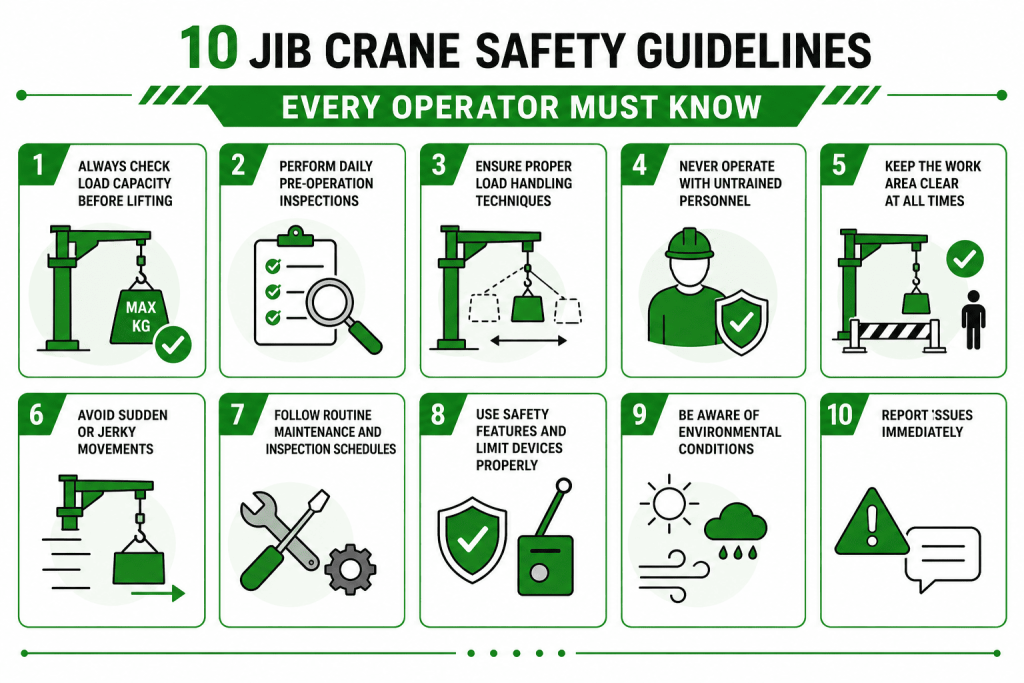
1. Always Check Load Capacity Before Lifting
Every jib crane is designed with a specific safe working load (SWL). Exceeding this limit is one of the most common causes of accidents.
Overloading can lead to structural stress, load instability, or even crane failure.
Best Practice
- Verify load weight before lifting
- Never exceed rated capacity
- Ensure load is evenly distributed
- Use proper lifting accessories suited to the load
Clear awareness of load limits is the foundation of jib crane safety in Malaysia.
2. Perform Daily Pre-Operation Inspections
A quick inspection before operation can prevent major failures.
Operators should check for visible signs of wear, damage, or malfunction, especially in high-usage environments.
What to Inspect
- Wire rope or chain condition
- Hook integrity and latch function
- Abnormal noises during movement
- Smooth rotation of the jib arm
- Control system responsiveness
If any issue is detected, the crane should not be used until it is properly inspected and repaired.
3. Ensure Proper Load Handling Techniques
Incorrect lifting techniques often cause load swings, collisions, and instability.
Safe load handling is critical to prevent accidents during operation.
Best Practice
- Lift loads vertically—avoid dragging or side pulling
- Keep the load balanced and secure
- Move loads slowly and steadily
- Avoid sudden starts or stops
Maintaining control of the load is key to reducing risk during lifting operations.
4. Never Operate with Untrained Personnel
Operator error remains one of the leading causes of jib crane incidents.
Without proper training, users may not understand load limits, safety controls, or correct lifting procedures.
Best Practice
- Only trained and authorised personnel should operate the crane
- Conduct regular safety training sessions
- Reinforce standard operating procedures (SOPs)
- Provide refresher courses when needed
A well-trained operator is the most effective safety measure in any lifting environment.
5. Keep the Work Area Clear at All Times
A cluttered or congested workspace increases the risk of accidents.
Obstacles can interfere with crane movement and create hazards for nearby workers.
Best Practice
- Keep lifting zones free from obstructions
- Ensure no personnel stand under suspended loads
- Mark designated lifting areas clearly
- Maintain clear visibility during operation
Safe surroundings are just as important as safe equipment.
6. Avoid Sudden or Jerky Movements
Abrupt movements can cause the load to swing uncontrollably, increasing the risk of impact or tipping.
Best Practice
- Operate controls smoothly and gradually
- Avoid rapid acceleration or braking
- Maintain consistent lifting speed
- Be mindful of load momentum
Controlled operation improves both safety and precision.
7. Follow Routine Maintenance and Inspection Schedules
Even well-operated jib cranes in Malaysia can fail if maintenance is neglected.
Over time, components such as bearings, bolts, and hoists experience wear and require servicing.
Best Practice
- Schedule regular preventive maintenance
- Lubricate moving parts as recommended
- Replace worn or damaged components promptly
- Keep maintenance records for compliance and tracking
Consistent maintenance is essential for long-term jib crane reliability and safety.
8. Use Safety Features and Limit Devices Properly
Modern jib cranes are equipped with safety features designed to prevent accidents.
However, these features are only effective when used correctly.
Key Safety Features
- Overload protection systems
- Limit switches
- Emergency stop controls
- Braking systems
Operators should never bypass or disable safety mechanisms.
9. Be Aware of Environmental Conditions
Environmental factors in Malaysia—such as humidity, heat, and dust—can affect crane performance.
Poor conditions may reduce visibility, increase corrosion, or impact electrical components.
Best Practice
- Adjust operations in poor weather or low visibility
- Inspect equipment more frequently in harsh environments
- Protect cranes from excessive exposure when possible
Understanding environmental impact helps prevent unexpected failures.
10. Report Issues Immediately
Small issues can quickly escalate into major safety hazards if ignored.
Operators should report any irregularities as soon as they are noticed.
Best Practice
- Stop operation if abnormalities occur
- Inform supervisors or maintenance teams immediately
- Do not attempt unauthorised repairs
- Ensure proper inspection before resuming work
Early reporting prevents accidents and reduces downtime.
Summary: Key Jib Crane Safety Practices
| Safety Area | Key Action |
|---|---|
| Load control | Never exceed capacity |
| Inspection | Perform daily checks |
| Operation | Use smooth, controlled movements |
| Training | Allow only certified operators |
| Environment | Maintain safe surroundings |
| Maintenance | Follow regular service schedules |
Why Following Jib Crane Safety Guidelines Matters
Implementing proper safety practices offers long-term benefits:
- Reduced workplace accidents
- Improved operational efficiency
- Lower maintenance and repair costs
- Compliance with safety regulations
- Increased equipment lifespan
For industrial businesses in Malaysia, safety is not just a requirement—it is a strategic advantage.
Improve Your Jib Crane Safety Today
Enhance workplace safety, reduce operational risks, and ensure long-term reliability with professionally designed jib crane solutions tailored to your lifting needs.
Final Thoughts
Accidents for jib crane in Malaysia are rarely caused by a single issue. They usually result from a combination of poor practices, lack of awareness, and neglected maintenance.
By following these jib crane safety guidelines, operators and businesses can significantly reduce risks while improving productivity and reliability.
Safe lifting starts with informed decisions, proper training, and consistent operational discipline.
Frequently Asked Question (FAQs)
The safe working load (SWL) depends on the crane design and specifications. It is clearly stated by the manufacturer and must never be exceeded during operation to prevent structural failure and accidents.
Operators should perform daily visual checks before use. More detailed inspections should be carried out monthly, with a full professional inspection conducted at least once a year or as required by safety regulations.
Common accidents include overloading, load drops, collisions due to load swing, and injuries caused by standing under suspended loads. Most of these can be prevented with proper training and safe operating practices.
No, only trained and authorised personnel should operate a jib crane. Proper training ensures operators understand load limits, safety procedures, and correct handling techniques.
Stop using the crane immediately and report the issue to your supervisor or maintenance team. The crane should be inspected and repaired by qualified personnel before it is used again.
Disclaimer Statement
We hope you found this article informative. Our content is intended for general informational purposes only and does not constitute advice or necessarily reflect the full range of services offered by Power Tiek Sdn Bhd
Readers are advised to consult with a qualified industry professional and contact our experts for crane recommendations specific to their individual project needs. While we strive for accuracy and completeness in our blog posts, we cannot guarantee they are error-free. Power Tiek Sdn Bhd assumes no responsibility for any errors or omissions.